Traction elevators have been used in commercial buildings for generations, but advances in elevator technology have made traction systems increasingly useful for residential applications. Traction elevators are particularly well suited for larger multistory homes where longer travel, multiple stops, smooth ride quality and quiet operation are important considerations.
A traction elevator uses an electric motor, drive sheave, suspension ropes or belts, and a counterweight to move the elevator car between floors. This counterbalanced design can provide smooth operation, efficient power use and excellent ride quality.
How Does a Traction Home Elevator Work?
The basic principle behind a traction elevator is relatively simple. The elevator car is suspended by steel ropes or specially designed belts that pass over a drive sheave. An electric motor rotates the sheave, causing the elevator car to travel up or down within the hoistway.
A counterweight travels in the opposite direction of the elevator car. As the elevator rises, the counterweight moves down; as the elevator descends, the counterweight moves up.
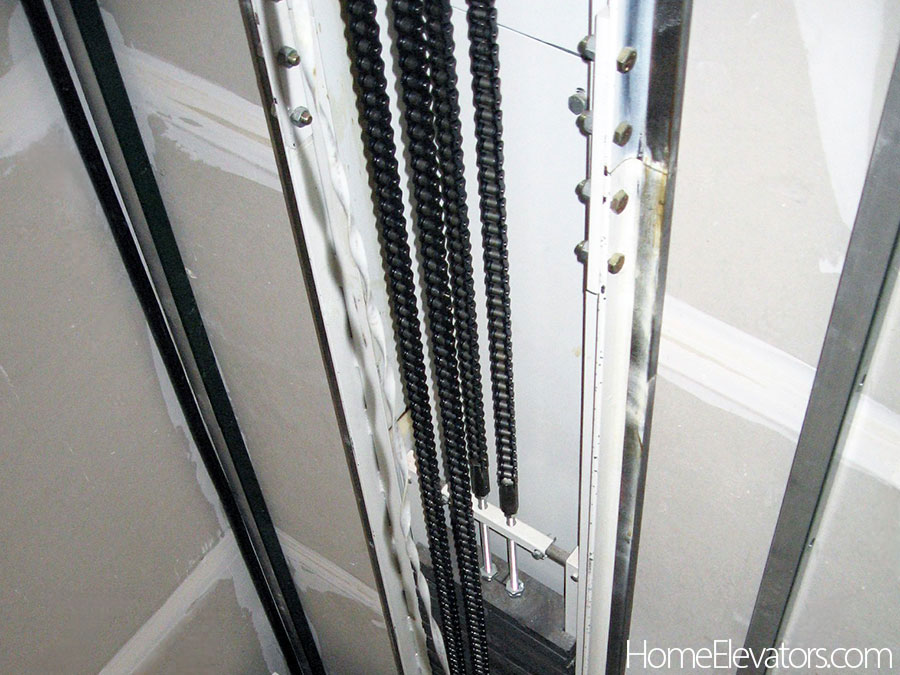
The counterweight balances much of the weight of the elevator car and its load. Because of this the system is balanced, the motor does not have to lift the entire weight of the elevator car each time it travels upward.
The term traction refers to the friction created between the suspension ropes or belts and the drive sheave. This traction allows the rotating sheave to control the movement of the elevator.
Geared and Gearless Traction Elevators
Traction elevators can generally be divided into two basic categories: geared and gearless. Both systems use an electric motor to drive a traction sheave that moves the elevator car using suspension ropes or belts and a counterweight. The primary difference is how the motor transfers power to the drive sheave.
Geared Traction
A geared traction elevator uses an electric motor connected to a gearbox. The gearbox reduces the motor speed and transfers power to the drive sheave that moves the elevator.
Geared traction systems have a long history in the elevator industry and can provide reliable performance for lower-speed applications.
Gearless Traction
A gearless traction elevator connects the motor directly to the drive sheave without a conventional reduction gearbox.
Modern gearless motors can be considerably smaller than traditional traction machines. Their compact size has helped make traction technology more practical for residential elevators and machine room-less installations.
Gearless designs can also reduce the number of mechanical components in the drive system while providing smooth acceleration and deceleration.
Advantages of Traction Home Elevators
One of the primary advantages of a traction elevator is its counterbalanced design. Because the counterweight offsets much of the weight of the elevator car, the motor only needs to overcome the difference between the car and the counterbalanced load rather than lifting the entire car without assistance.
Other advantages include:
- Efficient electric operation
- Smooth acceleration and deceleration
- Excellent ride quality
- Compact gearless drive equipment
- Machine room-less configurations on some systems
The actual performance, space requirements and electrical requirements vary considerably between residential elevator systems.
Traction vs. Machine Room-Less Elevators
Traction elevators and machine room-less (MRL) elevators are sometimes described as though they are separate drive technologies, which can make comparing residential elevators confusing. The terms actually describe different characteristics of an elevator. Traction describes how the elevator is driven, while machine room-less describes how and where the elevator’s drive equipment is installed.
The confusion occurs because many modern traction elevators are also machine room-less elevators. Compact traction machines can often be installed within the hoistway rather than in a separate machine room, so the same elevator may correctly be described as both a traction elevator and an MRL elevator.
However, the terms are not interchangeable. Not every MRL residential elevator uses a conventional traction drive system, and a traction elevator does not necessarily have to be machine room-less. Residential MRL elevators can use different types of electric drive systems depending on their design.
When comparing home elevators, it is helpful to look at the drive system and the equipment configuration separately. Traction identifies the technology used to move the elevator car, while MRL identifies an installation designed without a traditional separate machine room.
Space Requirements for a Traction Elevator
Traction elevators require a dedicated hoistway with guide rails to control the movement of both the elevator car and counterweight. The number, arrangement and configuration of the guide rails vary depending on the elevator design.
Equipment location varies by design. Some traction elevators have dedicated space for the drive equipment, while modern machine room-less traction systems can place much of the equipment within the hoistway.
Pit depth, overhead clearance, hoistway dimensions and structural requirements vary by elevator. These requirements should be considered early when designing a new home or planning an elevator installation.
Are there Disadvantages of Traction Elevators?
While traction elevators offer excellent ride quality and are particularly well suited for longer travel and multiple stops, they may not be the best choice for every home. Traction systems can have higher initial costs and more complex hoistway and installation requirements than some other residential elevator systems.
Traction elevators also require technicians familiar with this specific drive and control system. Service availability should be considered when selecting any elevator, particularly in areas where residential traction systems are less common.
For homes requiring only two stops and relatively short travel, the additional capabilities of a traction system may provide little practical advantage. Traction becomes particularly attractive in larger homes where longer travel, multiple stops, smooth ride quality and efficient operation can make better use of the system’s strengths.
Traction Home Elevators and Modern Residential Design
Traction technology represents an important development in the residential elevator market. What was once primarily a commercial elevator drive system is now available in configurations designed specifically for private homes.
Compact motors, sophisticated electronic controls and machine room-less designs have expanded the ways traction elevators can be incorporated into residential construction.
For homeowners comparing elevator technologies, traction is now an important option to consider alongside hydraulic, winding drum, machine room-less, shaftless and vacuum elevator systems.